Interior Stair Railing Design
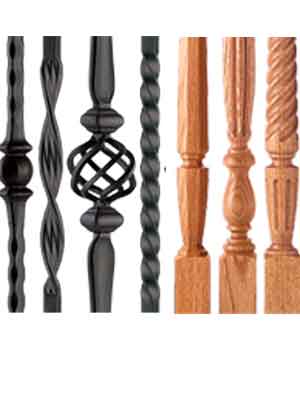
If you are looking for a way to add a little character to your floor level balustrade here is an idea that gives a new purpose to a standard stair part. Designing a distinct and memorable balustrade from the myriad components available definitely involves some creative thought. There is more to it than picking the right profile; you must also consider their quality and how well they will harmonize in the complete architectural design. I’ve spent a lot of time recently trying to point our customers in the right direction, to get them asking the right questions about the big picture, and so forth. Today, I’d like to make a very simple and specific suggestion. In addition to the standard components that make up interior stair railing design such as Newel Posts, Wood or Wrought Iron Balusters, Stair Treads and all of the accompanying accessories and moldings, here is a suggestion you might find interesting for your floor level balustrade.
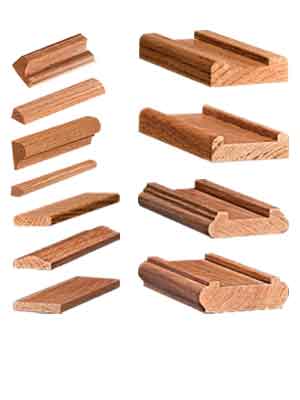
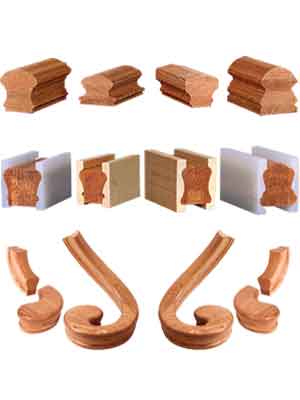
Handrail fittings are typically used in two scenarios, as a decorative termination to a handrail and to make a transition between two handrails that intersect at different angles. For example, the most common termination fittings are Volutes and Turnouts while Quarter Turns, Easings, and Goosenecks are standard transition fittings. So now for the big idea
Instead of using transition fittings as they are intended, you might consider using them to add a three-dimensional detail to your floor level balustrade. If you are planning a post-to-post system (if you are unclear what this is read more here), then instead of having the handrail terminate straight into the post, use fittings to give it a little flair just before the attachment. Because this is such rare practice, which is good and bad, I don’t have many pictures. Here is a before and after of one of WoodStairs.com’s customers remodel projects. While this balustrade is in a small space, the change and the goose neck fittings make a huge visual impact.
Balustrade Design
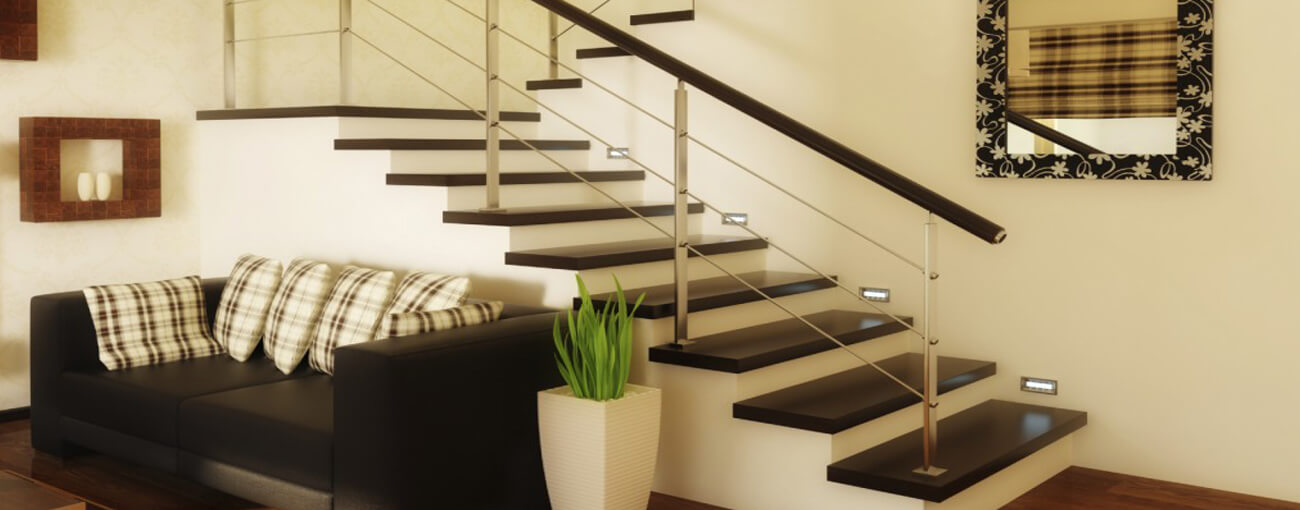
Balustrade design involves several steps that are narrowed down from concept to individual components. You may have an existing stair design from your house plans or that you intend to remodel. From this basic shape the first consideration is they style of the space. Balustrades are a very prominent feature in most architectural interior design. Together with the stairs themselves they are in essence a large and a very visual piece of furniture. Even more than paint, cabinets, accessories and furniture, because they are generally considered a permanent feature of your home, special consideration is warranted regarding your banisters. Of course stairs and balustrades can be renovated, or even repainted, but with a well-designed system this future need can virtually be eliminated. There are countless stairs and balustrades that are decades, even centuries old, and they remain as relevant to the home as the day they were installed. On the other hand, there are probably many more that never worked to begin with. So, what is the difference?
The complexity of this question makes it a difficult one to answer. Stairs and railings are typically designed with one of three purposes in mind; they can be a focal point, a subtile compliment to the space, or virtually invisible. Each purpose answers the question in a different way. If the stair is to be a focal point then the answer is often more visually apparent. The balustrade itself may be the driving force behind the tone and style of the space rather than vice versa. In such cases a more creative and unique design may be warranted to reveal the stair as the work of art it is intended to be. If your stair and balustrade is intended to compliment the space, which is the overwhelming majority of cases, the design selections are typically more interwoven with other features. Rather than stand on their own the purpose of these stairs is to contribute to the overall symmetry of the space, its accessories and embellishments. Finally, the invisible stair. In this case, the stairs and railings are intended to be a virtually nonexistent architectural feature. This may be in the case of minimalistic designs, or where another feature is the intended focal point.
Types of Stairs
There are several different types of stairs that are used in architectural design. These vary for a variety of reasons, two of the most important being their visual appeal and consideration of space. Stairways can occupy a rather large footprint in a home but through some creative design this footprint can be substantially reduced when necessary when space is at a premium. Here are the six basic stair shapes and their uses in a home.
Straight Stairs are the most common type primarily because they are very practical while being the most simple and inexpensive type of stairway. A straight stair is basically one that travels from one floor to the next without changing direction or curving.
L Shaped Stairs are basically two stairs that connect at a landing or by winder treads at a 90° turn. These are most often used when space is more limited and a full straight flight cannot fit. The intermediate landing or winder tread area of the stair may be centered between the two straight flights or nearer the top of the bottom. Winder treads are pie shaped treads that increase the number of treads in the “landing area” when space is even more limited.
U or Switchback Stairs are two flights (often of differing length) that run parallel and joined at the top of the lower flight and the bottom of the upper flight by an intermediate landing. The landing itself may also be partitioned into two square landings or several pie shaped winder treads to reduce the length of the straight flights and thereby reduce the overall footprint of the U shaped stair. Ideally, there is a space between the two parallel flights to allow room for skirt boards, stair tread overhangs and clearance between bypassing handrails. This distance may be as little as 6” to upwards of 12”.
Wood, Stone and Wrought Iron Balustrades throughout history
Houzz.com hosts the largest collection of decorating and interior design ideas on the internet, including staircases and balustrades, kitchens, bathrooms and more. WoodStairs.com is a proud contributor to this great resource of architecture, interior design and decorating, landscape design and home improvement. There is an article today on Houzz.com entitled “Lean on Me: Balustrades and Rails Through the Ages to Today”, by Gabrielle Di Stefano. Of course this article is especially interesting and relevant to those of us in the stair parts industry and as our customers we hope that you enjoy it as well. We appreciate the rich history of balustrades and their components, such as wrought iron balusters and wood box newel posts, and we are passionate in our efforts to further advance this legacy today. You can ready the Houzz.com article below. As always we are always here to help with any stair or balustrade related questions from design through completion at 888-390-7245.
How to install iron balusters : Part 3
If you want to know how to install iron balusters, there is now a third option and one we highly recommend for many of our customers. IronPro is a patented system that was developed by one of our suppliers, LJ Smith. It is an innovative and patented iron baluster shoe system that can be used in virtually any iron baluster installation situation. In new installations it can reduce installation times to 1/3 of normal and even better, in renovations, it allows you to replace wood balusters with wrought iron balusters without removing the post or handrails. So, if you have a damaged, outdated or plain ugly balustrade but don’t want to spend your hard earned money to replace the entire system, IronPro allows you to keep everything but the balusters themselves. All of your other stair parts remain intact. You can repaint or stain them if you would like, to freshen them up, but you do not have to replace them. Not only that but you don’t even have to remove and reinstall your newel posts, handrails, stair treads, etc. to install the balusters. So whether you are doing it yourself or hiring out the installation you will save money on labor as well.
Iron balusters installation using LJ Smith’s IronPro system is simple virtually anyone can do it. With everything in place (even stained or painted) except the iron balusters you simply add the IronPro shoes to the handrail and Stair Tread or Landing Tread, cut the balusters to length, insert them into the shoes and fasten them with the included set screws. Here is a youtube video that shows the process far better than I can describe it here. The tools required are minimal and we have no reservations recommending this system to even those with virtually no woodworking experience.
Newel Post Height
There are several methods of how to install a newel post but the first step is cutting them to the correct height. This height depends on the standard handrail height for your balustrade which is based on the building codes for your area. Typically floor level balustrades must be at least 36” high or 42” high, depending on local codes and stair guardrails must be between 34” and 38”. While these are the typical requirements as established by the International Residential Code, they do vary by area so make sure you know the codes that apply to your situation before you proceed.
Calculating the newel post height is the first step in newel post installation. The two most common scenarios are floor level posts and posts at the start of a stair. A third scenario is posts at a winder tread but this is a little more complicated so I will address this in a future post. So stay tuned
When using turned newel posts the objective in all scenarios is to have the rails terminate into the center of the top block. If you are using box newels then there may or may not be a space that is visually defined by a molding as the “top block”. If your post does not have this then there is no real rule, the rail simply terminates somewhere near the top of the post. In the other scenarios, when there is some type of visual top block the calculation is fairly simple. Using the following formula will center the rail in the top block.

Floor Level Post Heights are calculated to place the rail in the center of the Top Block using the following formula.
Selecting the correct Newel Post types for your balustrade
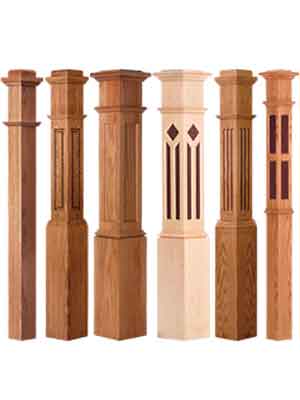
Wood Newel Posts are available in two main categories, each with virtually unlimited designs. These categories are Turned Newel Posts and Box Newel Posts. While there are countless designs there are also a couple of variations for each style, specific to their intended use. These variations are most important with Turned Newel Posts and it is my intention today to help you understand the reason for the variation in newel post types and how each is used in a balustrade.
There are two types of railing systems, continuous and post to post. Continuous railing systems are those in which the handrail is continuous over the top of each post in the system, achieved with specific types of posts and handrail fittings. The second type of balustrade system, post-to-post, is one in which the handrail terminates into the top block of each post. Systems using Box Newel Posts are always post-to-post while you have the option of either railing system when using turned newel posts; you simply need the right turned newel post for the job.
Continuous systems are fairly simple, they use dowel top posts which require a tandem style fitting that allows the rail to “balloon” over the top of the post uninterrupted. While these are available in different lengths for different applications the style remains consistent. The complexity in a continuous system is in the handrail fittings. Fittings such as goosenecks, easings and tandem or capped fittings are used to transition between different handrail heights over the top of the post. However, for a particular style of posts, the dowel top version simply does not have a top block, otherwise they are the same.
Red Alder Stair Parts
Red Alder (Alnus rubra) is the most common hardwood in the Pacific North West and the largest of the American Alders, reaching heights of over 100 feet. It has very little insect or disease problems or animal damage. It is a fast growing species and trees can grow to more than 30 feet at by five years of age, fifty feet by ten years and be seventy-five feet tall in only twenty years. Still, red alder is a relatively short-lived species, maturing at sixty to seventy years with a maximum age of about one hundred years. All of these factors, however, make alder an exceptional species for human use in green and sustainable forestry.
Alder stair parts are just one of the many applications to which this species is ideally suited. Because of how fast it grows and the heights it achieves in such short a time, it is relatively inexpensive. Although, alder lumber is not considered to be a durable option for outdoor applications, due to its workability and ease of finishing it is increasingly used in interior applications for furniture, cabinetry and hardwood stair parts.
Red Alder lumber ranges from white to light brown, with a relatively soft and smooth texture. It is very uniform in color because there is no visible boundary between the heartwood and sapwood . It has medium luster and easily worked, it glues well, and takes a good finish. Because of its uniformity, light color, and ability to take stain well, alder is often stained to imitate other, more expensive species such as cherry.